POS Shouldn't Do Everything: Why Restaurant Groups Need to Decouple Their Data
When transactions, membership, delivery, and review data are scattered across different systems, restaurant groups need to decouple data from the POS and redefine the roles of the omnichannel transaction hub, lightweight POS, open integration platform, and data foundation before AI can work reliably.
A quick note before we begin: My previous article, AI in Restaurant SaaS Shouldn’t Be Just Another Chatbot, ended with a question: if menus, orders, membership, payments, and reviews are still scattered across different service providers, which data should AI trust?
This time, I want to put the models aside and go back to the underlying operating architecture of a restaurant business.
When restaurant groups talk about digital transformation, their first move is often to choose a new system. When they talk about AI, their first question is often which model to use.
But from what I have seen across several restaurant chains, the real bottleneck is often neither the model nor a missing system feature. The problem sits deeper: transaction, membership, delivery, review, and enterprise management data remain in separate systems, each speaking a different language.
If the underlying problem is that data follows the system, replacing the POS with a heavier one simply shifts even more responsibility onto another system.
A more sensible direction is a lightweight POS paired with an omnichannel transaction hub. Whether that architecture can work depends first on whether the data can be decoupled.
The traditional architecture: POS as the centre of transactions and fulfilment
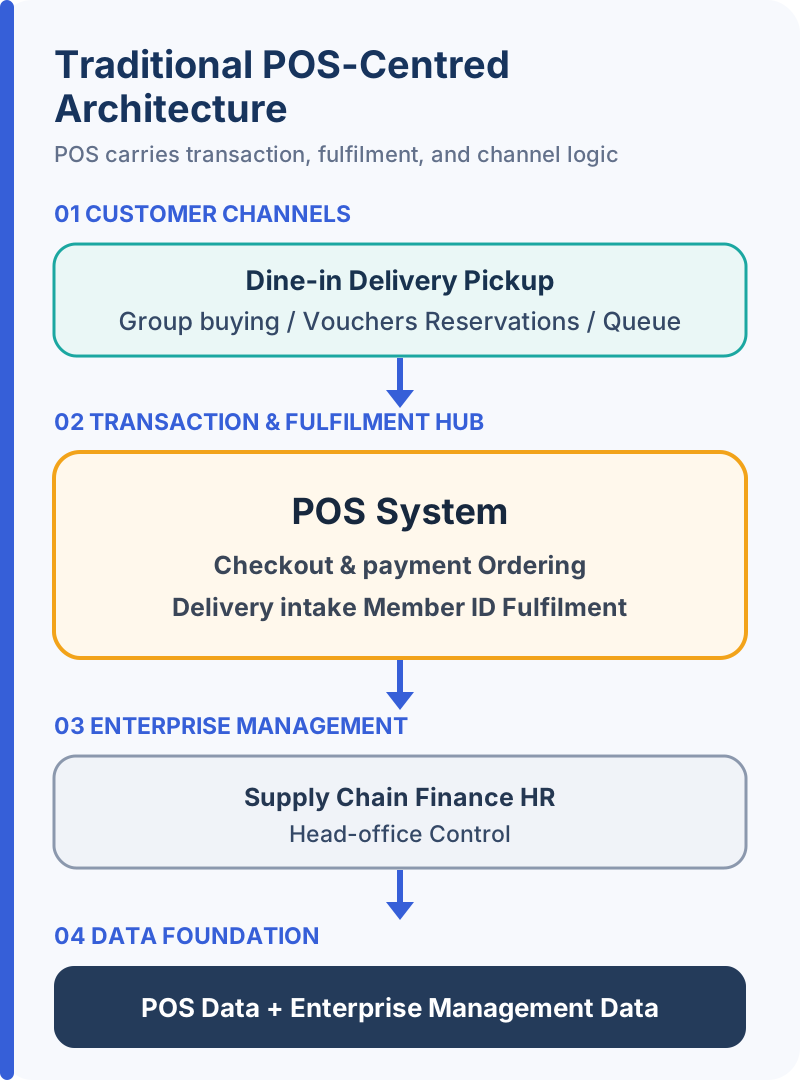
The operating architecture of a traditional restaurant business is straightforward.
Customers arrive through dine-in, delivery, pickup, group buying, or reservations, and the transaction eventually lands in the POS. The POS handles checkout and payment, ordering, delivery order acceptance, member identification, and fulfilment records. It then works with supply chain, finance, HR, and head-office management systems.
There is nothing inherently wrong with this architecture.
For a restaurant, the POS has to be dependable. Whether it can take payment when the internet goes down, send orders to the kitchen, and trace refunds matters far more than how elegant the architecture diagram looks. When there are only a few channels and most business happens in the restaurant, a POS-centred model makes sense.
What has changed is the number of channels—and the data each channel controls.
Once a restaurant uses dine-in QR codes, delivery platforms, pickup channels, reservations, queue management, and membership systems at the same time, every system may have its own store IDs, product names, prices, order statuses, and customer identities.
The same drink may have different product IDs in the POS, delivery platform, and membership system. The same order may carry three different statuses across the delivery platform, restaurant, and courier system.
Even “revenue” may not have a single answer. Finance may care about cash received, operations about the original order value, while a platform report may include subsidies, service fees, or refund adjustments.
An interface can move data from one place to another. It cannot automatically tell the group which definition is authoritative.
Suppose a group wants to connect a poor review from a particular location and time period to the kitchen’s preparation time. The review, order, and KDS data may all exist, but the systems may not share a consistent store, time, or order identifier that can link them together.
This is why, in my article on multi-platform delivery order integration, I argued that integration cannot stop at putting every order on the same screen. The real challenge is whether menus, statuses, fulfilment, refunds, and reconciliation can enter one consistent workflow.
The omnichannel architecture: first, change where transactions live
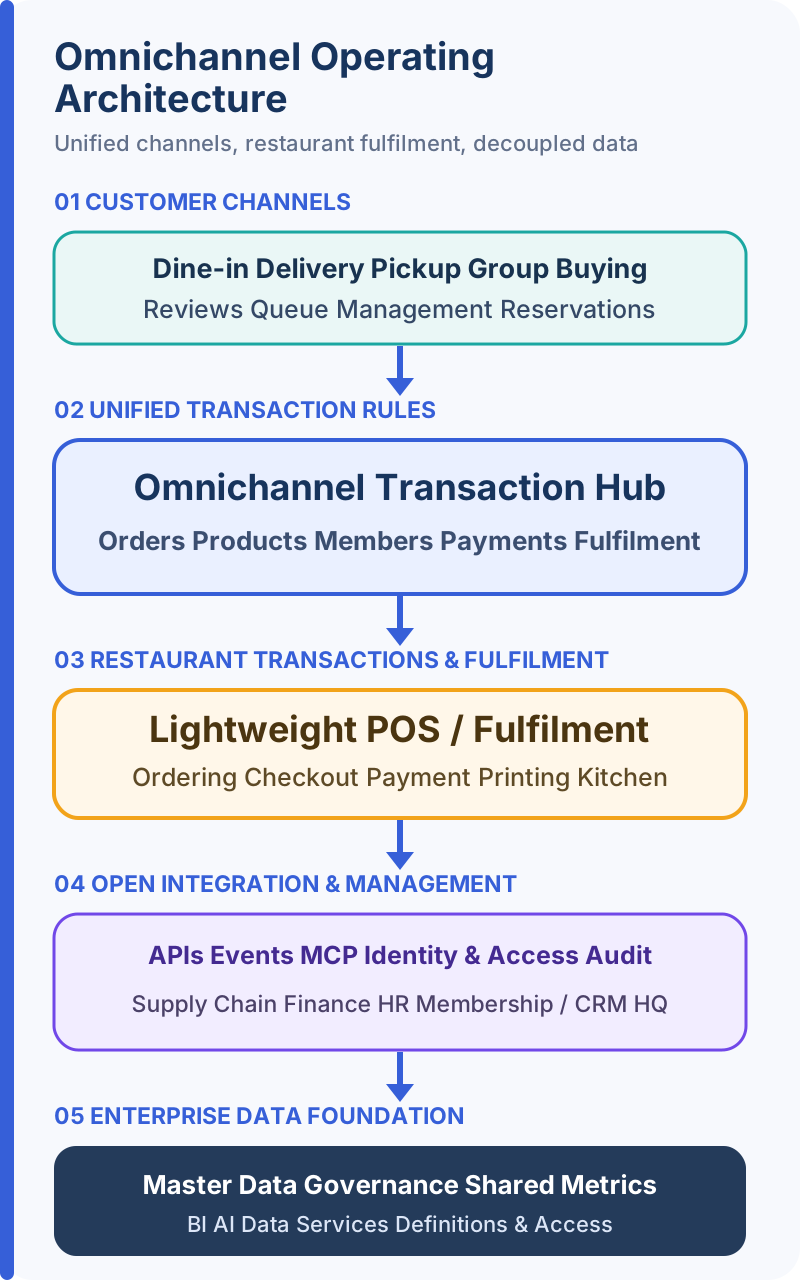
Omnichannel digitalisation does not mean removing the POS or replacing every restaurant system at once.
It starts by separating two responsibilities that were previously mixed together inside the POS:
- The omnichannel transaction hub standardises rules for orders, products, marketing, membership, payments, and fulfilment.
- Restaurant systems receive instructions and handle ordering, checkout, food preparation, service, and status updates.
Customers may enter through dine-in, delivery, pickup, group buying, reviews, queue management, or reservations. Regardless of the entry point, the transaction first passes through a common set of rules before being sent to the restaurant for execution.
This architecture also requires two horizontal capabilities.
The first is an open integration platform that connects delivery, payment, reservation, membership, and local service providers in different markets. APIs are only one part of the picture; events, identities, permissions, and activity records must also be managed.
The second is a data foundation responsible for master data, data governance, standardised metrics, BI, and AI data services. The integration platform determines how systems connect. The data foundation determines how data is understood, authorised, and traced.
The most important change is not the addition of another “middle platform.” It is that the POS is no longer forced to understand the rules of every external channel.
A lightweight POS is not about having fewer features—it is about clearer boundaries
The traditional approach is to add a new interface and another set of rules to the POS every time a new channel appears.
Over time, the POS becomes responsible not only for ordering, checkout, and food preparation, but also for understanding delivery platforms, membership, marketing, reservations, payments, and head-office management. The system becomes heavier, and every restaurant upgrade carries a greater risk of disrupting frontline operations.
A lightweight POS takes the opposite approach.
The restaurant terminal retains the capabilities that matter most on site and cannot afford to fail: ordering, checkout, payments, printing, food preparation, and basic fulfilment. Products, membership, channels, marketing, and cross-location rules are managed centrally by the omnichannel transaction hub.
“Lightweight” does not mean doing less. It means that every restaurant terminal no longer has to carry the complexity of the entire group.
The POS stays close to the restaurant and ensures that transactions can be completed on site. The transaction hub stays close to the channels and standardises business rules. The data foundation preserves the shared definitions and access rights the business needs over time.
How the two architectures differ
| Dimension | Traditional POS-centred architecture | Omnichannel operating architecture |
|---|---|---|
| Transaction core | POS handles both transactions and fulfilment | Transaction hub standardises rules; POS handles restaurant fulfilment |
| Customer entry points | Each channel connects to the POS separately | Dine-in, delivery, pickup, reservations, and other channels follow common transaction rules |
| Restaurant terminal | Handles both channel interfaces and on-site operations | Lightweight POS focuses on ordering, checkout, payments, printing, and food preparation |
| System integration | Interfaces are connected one by one | APIs, events, identities, permissions, and audit trails are managed together |
| Data | Defined by each individual system | Shared identities, metric definitions, and access rights |
Data decoupling is not about moving databases
Talk about data decoupling can easily turn into another large-scale data warehouse project.
But the point is not to copy all raw data into one place. It is to make sure the company’s operating definitions do not depend on a single service provider.
Three layers of responsibility need to coexist.
The first is restaurant operations. Data should first explain how a restaurant runs its business—not how a particular system stores a record.
The second is the service provider ecosystem. Each market can use the delivery, payment, membership, reservation, and courier services that fit it best. But when those services connect to the group, they must follow common identity, event, and data definitions.
The third is the enterprise data foundation. It does not replace business systems, nor does it need to own every piece of raw data. Its role is to establish consistent identities for locations, products, channels, and orders; define orders, refunds, revenue, and repeat purchases consistently; and manage data sources, customer consent, and access rights.
Customer identity and consent, in particular, cannot rely solely on channel platforms. This follows from my earlier discussion of how restaurants should retain ownership of customer relationships.
A restaurant may not be able to control all the raw data held by every platform, and it does not need to build every system itself. But it should own its operating data model.
Otherwise, replacing a POS, delivery aggregator, or membership provider may also mean rebuilding reporting definitions, historical analysis, and automation capabilities. That is not integration. It is simply moving dependency from one system to another.
Why so many restaurant groups struggle to make this work
The hardest part is often not the interface. It is ownership.
Data is scattered across finance, operations, IT, brand, and other teams, which may all use different definitions. Product names, store codes, and order statuses may be inconsistent across legacy systems. Membership, review, and transaction records also come with access and privacy boundaries.
The group must decide who owns the shared definitions, who can use the data, and which operating capabilities and historical records must survive when a service provider is replaced.
This is why data decoupling is not just an IT project. It is also a question of management responsibility and product boundaries. If these questions are not resolved first, the data platform can easily end up holding a collection of connected data that still does not align.
Why AI must come after data governance
Let us return to the opening question. If the same product has several IDs, the same order has multiple statuses, and revenue has no shared definition, AI may analyse the data quickly—but it will not know which answer to trust.
When AI is used only to organise text, the result may simply be an inaccurate summary. But when it begins to recommend inventory levels, detect anomalies, adjust products, reply to customers, or even create orders on behalf of external agents, bad data moves directly into operations.
Before choosing a model, a restaurant group therefore needs to answer:
- Which data may the AI use?
- Which system provides the final confirmed price and inventory level?
- Do all locations use the same metric definitions?
- Has the customer agreed to the use of their data for this service?
- Who approves the AI’s recommendations and actions, and can those actions be reversed and audited?
The value of a data foundation goes beyond BI reporting. It must make data identifiable, understandable, authorised, and traceable before that data can be handed to AI. The data must flow before the architecture can become lighter.
What should change first when moving beyond a POS-centred model?
The answer is not to buy a larger platform or replace every restaurant system at once.
I would start with three things:
- Map every customer entry point, transaction flow, and fulfilment system to identify which service providers touch the same piece of business.
- Find out how many different identifiers and definitions currently exist for locations, products, orders, customers, and channels.
- Decide which system is responsible for each type of data, then establish common interface, event, and permission rules.
Once these three steps are complete, the business can see what should remain in the POS, what belongs in the transaction hub, and what needs to be retained in the data foundation.
There is no need to make everything complete from day one. Start with one real workflow: a delivery order entering the restaurant, a refund returning to finance for reconciliation, or a member being identified across different channels. Make that flow work end to end.
Architecture does not start with a diagram. It starts with whether a single order can be fully understood and traced.
Conclusion: the POS still matters, but it should not do everything
Moving from a traditional restaurant architecture to an omnichannel one does not mean replacing the POS.
The POS still needs to protect restaurant transactions and fulfilment. What must change is the expectation that it should also understand every channel, every market, every service provider, and every data rule.
A more sensible model is for the lightweight POS to handle on-site transactions and fulfilment, the omnichannel transaction hub to standardise channel and business rules, and the enterprise data foundation to preserve shared definitions, permissions, and historical continuity.
When service providers can be replaced, data definitions can endure, and every transaction can be traced, the business is finally in a position to use its data for cross-market management, automation, and AI.
Data decoupling is not about sidelining the POS. It is about letting the POS return to what it should do best: serve the restaurant and complete the transaction.
🔧 Admin
Comments · 0 comments
Please use your name and stay on topic; abusive or spammy content will be removed.
Loading…