From One Store to One Hundred: When Does a Restaurant SaaS Business Need a Data Hub?
A data hub is not something you buy when you reach a certain store count. This article uses the growth curve from one store to one hundred to show when a restaurant group should bring POS and channel data into a governed common foundation.
A note before we start: My previous article, Why Restaurant Groups Need to Decouple Their Data, described the target architecture: a lightweight POS, an omnichannel transaction hub, and a data foundation.
But an architecture diagram does not answer the more practical question: when do you actually need a data hub?
I have seen two extremes. One group builds a data warehouse as soon as it opens its first store, before the operating systems are stable. The hub then sits idle. Another keeps pulling reports from individual POS terminals long after the business has grown, until the data becomes too messy to recover.
This article is about timing. From one store to one hundred, at what stage does a data hub start to pay for itself?
The short answer: a data hub is a product of scale, not a starting configuration
With one store, most data sits in the POS. The owner can still understand sales, inventory and members directly. Installing a data hub at this stage is like putting navigation on a bicycle—not impossible, but the cost and complexity are out of proportion.
As stores, channels and service providers multiply, the business needs cross-store comparisons, a shared customer identity and consistent reporting. Without a governed data layer, that complexity becomes a management risk.
The real question is not whether you need one, but when: when the cost of manual reconciliation, spreadsheet work and system replacement becomes higher than the cost of building a shared data layer.
Four stages: when data starts to get out of control
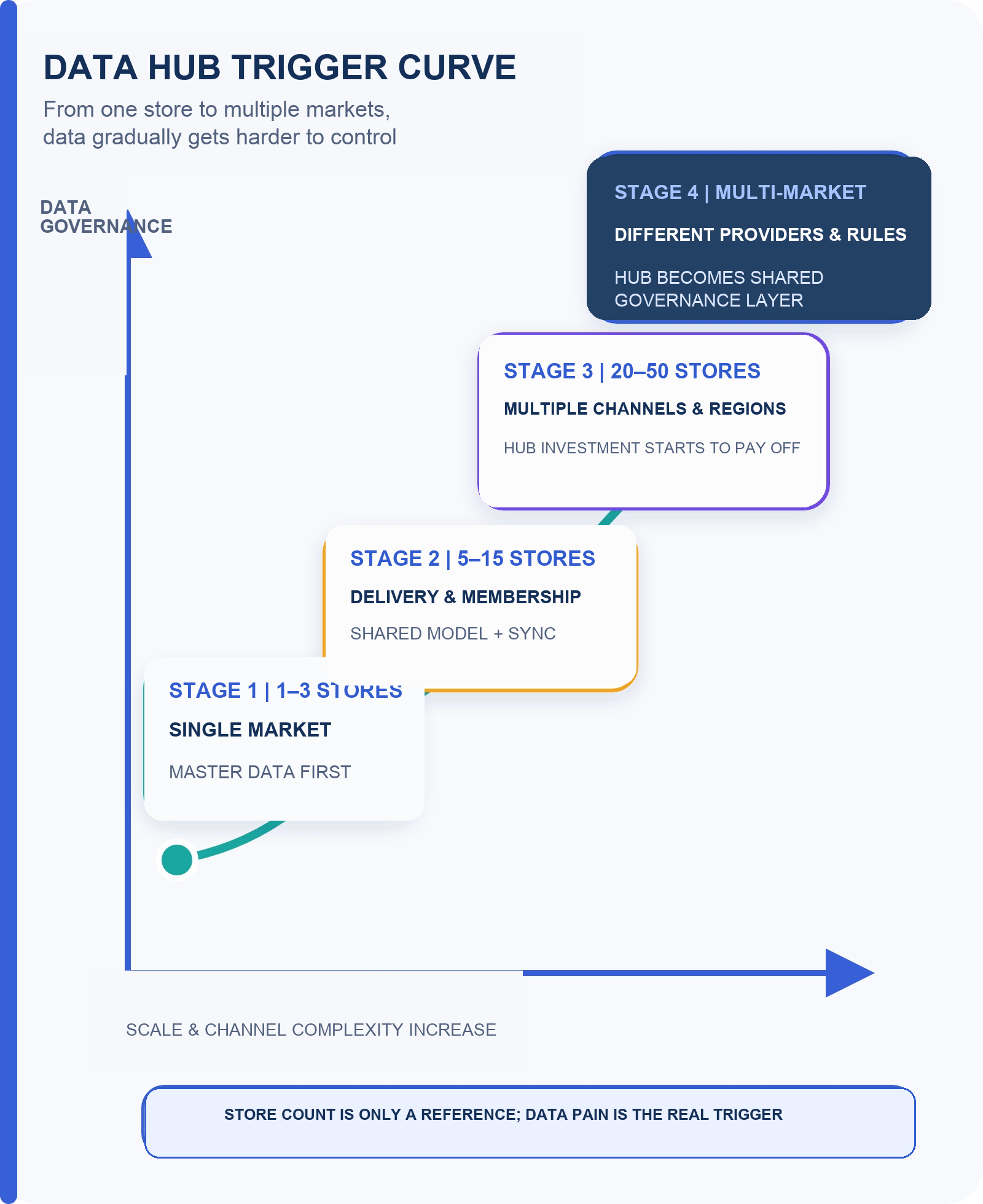
The store counts below are reference points, not hard thresholds. The number of channels and the complexity of operating across markets often trigger the need earlier than store count does.
Stage 1: 1–3 stores, one market
Data is mostly in the POS, with one report per store. Product codes, members and revenue definitions are still relatively easy to keep consistent.
But the cracks have already started. A customer tops up at Store A but Store B cannot see the balance. The owner wants the combined sales of three stores and has to export each report and add them in Excel. The same curry chicken rice has three different names or codes across stores. These problems are still tolerable—but they are already future data debt.
You probably do not need a data hub yet. You do need master-data discipline: define store, product and channel codes from day one. That is the foundation for future decoupling and governance.
Stage 2: 5–15 stores, with delivery and membership
Multi-platform delivery, owned membership and reservations begin to arrive. Data starts to split. The same drink may have one code in the POS and another on a delivery platform; finance looks at net receipts while operations looks at the original order value.
As discussed in Multi-Platform Delivery Order Integration, integration cannot stop at putting orders on the same screen.
You do not need to build a complete data hub all at once. Start with a shared data model and scheduled synchronisation for stores, products and orders. That is the minimum viable form of data decoupling.
Stage 3: 20–50 stores, multiple channels and regions
Cross-store membership, shared promotions, consolidated finance and regional comparison arrive at the same time. The problems become hard to ignore:
- Cross-store reconciliation depends on manually assembled spreadsheets;
- replacing a POS or membership provider means rebuilding reports and history;
- yesterday’s group-wide revenue takes several days to calculate;
- review data cannot be connected to kitchen preparation time for the same store and period;
- the same dish has different names, codes and prices across stores;
- headquarters spends days assembling a group-wide revenue report while reviews remain scattered across Google, OpenRice, GrabFood and foodpanda.
This is often the stage at which a data hub becomes worth the investment. The business needs governed master data, event synchronisation, a consistent metrics layer, permissions and audit trails—the data foundation described in the previous article.
At this point, the problem is no longer whether you need a data hub. It is the cost of not having one. Once the same problem is multiplied across dozens of stores, the time spent cleaning data starts to exceed the time spent using it to make decisions.
Stage 4: 100+ stores, operating across markets
Once the group enters different countries or regions, each market may use different delivery, payment and membership providers, currencies, tax rules and languages.
The value of a data hub is no longer just integration. It lets headquarters compare markets while preserving local provider flexibility. It should work with an open integration platform, not replace every local system.
Do not let store count fool you: look for the signals
The stages are only rough references. A group with relatively few stores but many channels and an overseas expansion plan may need a hub earlier than a larger, single-market operator.
The real signals are these questions. If several start appearing at the same time, start evaluating a data hub instead of continuing to patch the gaps manually:
- Different people give different answers to the same question. Finance, operations and delivery platforms each report a different figure for last month’s revenue. The issue is often the definition, not simply a calculation error.
- The same dish has different names in different systems. Without a common identity, cross-channel comparison is wishful thinking.
- Changing a provider means rebuilding reports and historical data from scratch. Your history is locked in the provider’s back office.
- Headquarters waits for each store to upload its report. You may not even know which stores are complete.
- Delivery and dine-in orders do not reconcile. Order IDs, refund states and POS records have no common reference.
- You are preparing to expand overseas and need comparable market data. A hub can standardise definitions while preserving local flexibility.
A data hub is not bought by store count. It is justified by the management problems that have already appeared.
What a data hub is not
Set the boundaries first, or the project turns into another oversized data-warehouse programme.
- It is not about moving every piece of data into one place. Raw transactions can remain in the POS, membership data in the membership system and review data on each platform. The hub translates between systems so they can be understood as one language.
- It is not a bigger BI tool. BI consumes data and visualises it; a hub governs the definitions first. If the definitions conflict, a prettier dashboard only displays the contradiction more elegantly.
- It is not a one-off project. Build one workflow, use it, then expand. Trying to build the whole building at once often means the requirements change before anyone moves in.
- It does not replace the POS, delivery, membership or supply-chain systems.
Its job is to make data identifiable, understandable, permissioned and traceable. The prerequisite is the data decoupling described in the previous article; otherwise the dependency has simply moved from one system to another.
A data hub and a transaction hub are not the same thing
If a company has a data hub but no shared transaction rules, the problems remain. The same product may have different prices by channel, an order may have different states in the platform, store and finance systems, and a completed refund may never update the member’s repeat-purchase history.
A clearer division of responsibility is:
- Lightweight POS: frontline transactions and fulfilment;
- Transaction hub: shared rules for orders, products, payments, members and channels;
- Data hub: shared identities, metrics, permissions and history;
- Service ecosystem: delivery, payment, membership, reservations and other local capabilities.
A data hub is not a patch for every API problem. Transaction rules need to be clarified first; otherwise the hub only receives another set of contradictory data.
Customer data belongs in this layer too
A data hub should cover more than transactions and revenue. It also needs to govern customer identity, first-party data and consent status.
Delivery platforms can bring the order without bringing the customer relationship back to the restaurant. As discussed in Who Owns the Customer Relationship?, restaurants need their own points of contact. The hub is the technical foundation for recognising the same customer across channels and enforcing the boundaries of data use.
AI comes after data governance
The first step for a restaurant group adopting AI is not choosing a model. It is answering:
- Which data may the AI use?
- Which system has the final say on price and inventory?
- Do all stores use the same definition for each metric?
- Has the customer consented to this use of their data?
If the same product has multiple codes and the same order has multiple states, AI does not know which answer to trust. It will simply produce a plausible wrong answer faster. When it starts recommending stock, finding anomalies or replying to customers, bad data enters operations directly.
As I wrote in AI in Restaurant SaaS Should Be More Than a Chatbot, AI needs trusted, permissioned data. The data hub is that foundation—not something to be pushed directly into every POS terminal.
Where to start: do three things first
If this sounds familiar, do not rush to buy a platform.
First: map the landscape. Draw every customer entry point, transaction flow and fulfilment system. Identify which providers touch the same business event. A sheet of paper is enough.
Second: find duplication. Count how many IDs and definitions exist for stores, products, orders, customers and channels. You may find five names for one dish and three IDs for one member.
Third: choose one workflow. Do not build the entire data hub at once. Pick the workflow causing the most pain—usually delivery reconciliation or cross-store membership—and make that one work first.
Other practical starting points include:
- cross-store delivery reconciliation;
- customer identity across stores;
- linking negative reviews to kitchen preparation time;
- synchronising out-of-stock products across channels.
Establish shared dimensions and governed metrics before adding more data. After each workflow, check whether the data is traceable, whether system ownership is clear, and whether history survives a provider change.
The value of a data hub is not more data. It is less time spent reconciling numbers and more time spent making decisions.
What happens if you do not build one?
The short-term cost is efficiency: reports need to be assembled, members need to be looked up and reconciliation becomes guesswork.
The long-term cost is lock-in. Your operating data, history and customer assets remain inside one provider’s system. Replacing the POS, delivery aggregator or payment provider becomes expensive enough that you hesitate to do it.
A data hub is not for better-looking reports. It keeps operating definitions, history and data assets under the business’s control. With that foundation, AI has something it can trust.
Conclusion: the question is not whether, but when
Restaurant groups usually need a data hub not because they have reached a particular store count, but because people can no longer understand the differences between systems manually.
Protect master-data discipline from the first store. When cross-store, cross-channel and cross-market signals appear, upgrade the decoupled data foundation into a proper hub.
A lightweight POS keeps the store focused on transactions and fulfilment. A transaction hub standardises business rules. The service ecosystem provides specialised capabilities. The data hub lets the group know whether different systems are actually describing the same thing.
A data hub is not about owning more data. It is about letting different stores, channels and departments make decisions from the same data.
The real starting signal is simple: you are using manual work to resolve inconsistent data, and that work is taking more and more time. Do not wait until the problem has spread across the whole group; cleaning years of inconsistent data usually costs far more than governing it early.
The next article will look at a different question: when a market’s language, payments, platforms and tax rules are highly fragmented—such as Canada—does a data hub remain optional, or does it become a condition for survival?
Further reading
- Why Restaurant Groups Need to Decouple Their Data — the target architecture, and why POS should not carry everything.
- A Lightweight POS Is Not a Small POS — which responsibilities the store terminal should keep or let go.
- AI in Restaurant SaaS Should Be More Than a Chatbot — why AI should follow the data hub and data governance.
- Delivery Platforms Bring Orders, but Who Owns the Customer Relationship? — why the hub needs to hold first-party customer data.
🔧 Admin
Comments · 0 comments
Please use your name and stay on topic; abusive or spammy content will be removed.
Loading…